From Copying a Craft to Making It Your Own
Learn how to move from copying a craft example to making it your own, with clear ways to study a model, adapt its principles and develop your judgement.
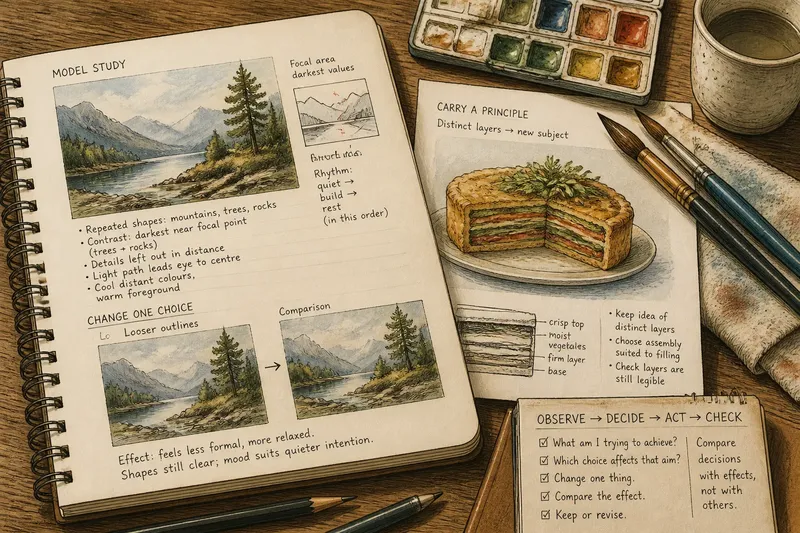
Copying a craft example becomes useful in a new way when you can explain what you are borrowing. In a sketchbook, that might mean keeping an artist’s approach to shadow while choosing a different subject; in a draft, it might mean studying a scene’s rhythm without borrowing its characters. The distinction turns imitation from a finished destination into a way to understand your own decisions.
There is no single moment when you must stop copying. Some parts of a craft may feel familiar while others still need close study. The question is not whether a piece looks original, but whether you understand the choices behind it well enough to make informed ones of your own.
Study a model for its decisions, not just its appearance
Choose an example within reach and look at it before you begin. What is repeated? Where does the maker create contrast? Which details are left out? In a short story, you might mark where a scene changes direction. In a piece of embroidery, you could notice how a limited set of stitches creates texture.
Make a small copy or study, then add notes beside it. Name what you can see: “the darkest tone sits near the focal point” or “the second sentence interrupts the first rhythm”. These observations give you something more useful than a vague impression of style.
If you share a study, identify it as an exercise and credit the source where appropriate. If you plan to publish or sell work derived from someone else’s piece, consider permissions and the conventions of the craft. For legal questions about a specific work, seek qualified advice.
Change one choice and see what it does
When the model’s structure feels familiar, alter a single feature you can name. Keep the rest steady enough to compare the effect. You might change the viewpoint in a drawing, the pace of a paragraph, or the spacing in a hand-lettered phrase.
Say you can reproduce a small arrangement of pears but want the drawing to feel less formal. Keep the fruit, composition and light direction; use looser outlines. Compare the versions. If the shapes remain clear and the mood feels more relaxed, the change served your aim. If the outlines obscure the fruit, you have learned where looseness stops helping.
Give the change a purpose before you start. “I want the scene to feel quieter” points towards choices you can make and assess. “I need to be more original” is too broad to guide a particular alteration.
Carry a principle into a different subject
Sometimes the model’s details no longer fit, but its underlying idea does. Separate the two before adapting the work: identify what the example is doing, then decide whether that purpose matters in your own piece.
Imagine you have studied a layered tart and want to make a savoury version with ingredients that release more moisture. Your starting point is the original method and those wetter ingredients. You keep the idea of distinct layers, choose an assembly suited to the filling, and make the tart. If the layers remain legible, the principle transferred; if they merge, you have a clear reason to revise the assembly rather than copy every detail. This invented situation illustrates a decision, not a claim about a particular recipe.
The same distinction works in other crafts. A writer can borrow the idea of delaying an explanation while creating a different scene and voice. A potter can study how a broad rim balances a form, then make a vessel for another use. In both cases, the maker carries an idea forward without treating the original surface as a template.
Choose what to practise by what you can observe
Use the result you want to understand to choose the exercise. Each observation should point to a decision, with another action available if the first choice does not fit.
- If you lose track of the sequence: check whether you can name the model’s actions in order. If not, copy a short section and mark each transition; if you can, practise that section without looking at the model.
- If your copy feels stiff: check whether the shapes or phrasing match but the intended mood does not. If they do, change one expressive feature, such as line quality or sentence length; if they do not, return to the basic structure before adding style.
- If you cannot tell which change mattered: check whether you altered several features together. If so, repeat the exercise with one alteration; if only one changed, compare the result with your stated aim and keep or reverse that choice.
- If the model’s materials or subject do not suit yours: check which principle still serves your purpose. If one does, retain it and replace the unsuitable details; if none does, choose a different model rather than forcing a poor fit.
- If your work looks too close to a source: check which distinctive features you have carried over. If those features are not necessary to your learning aim, change the subject, arrangement or expression; if the work remains recognisably derived and you plan to share it, clarify attribution and permissions first.
- If your notes turn into self-criticism: check whether they describe an observable effect or judge your ability. If they judge you, rewrite them as a specific observation; if they already name an effect, use that note to select the next technique to practise.
How do you know what to do next?
Should you keep a version that did not work?
Keep it if it helps you compare a decision with its effect. A saved draft, dated sketch or short audio recording can make that comparison easier; discard it when it no longer helps you understand the work.
How much should you change at once?
Change one feature when you are trying to understand its effect, and keep the other choices steady. Once you can anticipate what an alteration might do, combining decisions can help you build a more individual piece.
When can you move beyond close imitation?
Move on when you can name some of the model’s choices and reproduce the relevant technique without checking every detail. You do not need a perfect copy; you need enough understanding to decide what is worth keeping.
How can you develop your own style?
Pay attention to choices that serve your subjects and intentions, then use them consistently where they fit. Style tends to become recognisable through a pattern of considered decisions, not a single declaration that a piece is original.
Build judgement through deliberate comparison
Imagine you have practised watercolour landscapes by following a tutor’s demonstration. Your starting point is a study in which you can arrange the main light and dark shapes, but the view still feels like the demonstration. For a new painting, keep that arrangement method, choose a viewpoint from a familiar place and use a quieter palette. Compare the new painting with your study: if the light-and-dark structure still reads and the chosen palette better reflects the place you intended to paint, keep those decisions. If the palette weakens the structure, return to the earlier colour choices and change the viewpoint alone next time. The values and outcome here are invented; the example shows how to make a comparison, not what every painter should choose.
That kind of comparison gives you a record of what you meant to do and what the work actually communicates. Over time, you can see which techniques remain useful across subjects and which belong to a particular model. The phrase “copying a craft example” then describes a starting method, not a limit on what you can make.
Before your next study, write down the specific element you intend to borrow: a sequence, a principle, or one technique. That note makes it easier to recognise when your own subject calls for a different decision—and when the original approach is still the right one.